Everyone learned it on the back of a notebook. Two careful players never lose, and never win.
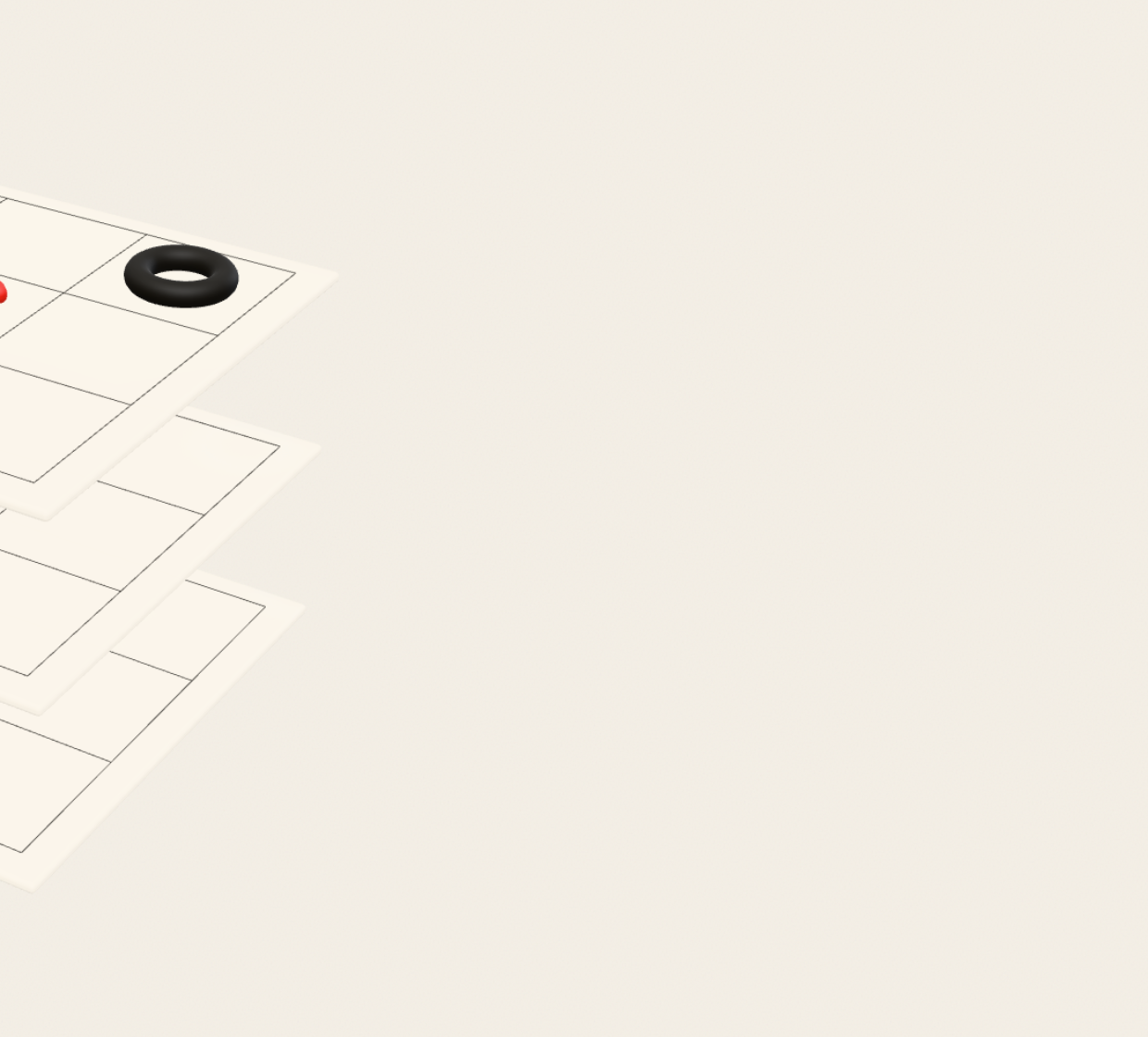
Now stack it. Two more sheets of glass: one above, one below.
Twenty-seven cells. Forty-nine ways to win. Most of them are hiding.
02Any line
A line can run anywhere.
Along a layer: the row you know.
Straight down a pillar, through all three sheets.
Up a face, corner to corner.
Or through the middle of the cube, corner to opposite corner.
The centre cell alone sits on thirteen of them. Take it, and the machine already knows how the game ends.
49ways to win
03Pull it apart
Read it one sheet at a time.
A line that climbs through the cube is easy to miss while the glass is stacked.
So pull the layers apart (E in a game) and drag the cube round.
Beside the board, small grids show every layer from above: the honest way to read it, and the only way on a phone.
Top
Middle
Bottom
04The machine
It has already seen the end.
It opens in the centre, the one cell on thirteen lines.
It answers every threat a move before you make it, and it never forgets a fork.
Seven marks. Corner to corner. The 3-cube is a first-player win, and the machine holds the proof.
16,000,000
positions a second, on your device
0.5 s
to solve the 3-cube from an empty board
49 · 76
lines it counts on every move
05Four machines
Pick how carefully it plays.
The machine always knows the best move. The easier levels sometimes play a slightly worse one: carelessness, not blindness. Pick one here; it applies to your next game.
06The big cube
Then make it four.
Sixty-four cells. Seventy-six lines. Four in a line to win.
The machine looks five or six moves ahead in here. Nobody sees that far.
Still a first-player win on paper: Patashnik proved it in 1980. On glass, nobody has.